Last updated October 15, 2026
DIY vs Professional ADU: The Long Beach Homeowner’s Decision Guide
You can legally act as your own general contractor in California. Pull an owner-builder permit for an ADU in Long Beach, though, and two things happen that most DIY guides conveniently skip: you accept personal liability for code compliance for 10 years, and you cannot rent that ADU out for the first year without voiding key legal protections. This guide walks through the real math behind the DIY-versus-professional decision in Long Beach, what owner-builder status actually means under California law, where inspectors consistently flag owner-built work, and how you can save real money on an ADU without signing up for a decade of legal exposure.
Quick Answer
For most Long Beach homeowners, hiring a professional ADU contractor is the safer financial decision once permit risk, inspection corrections, and the 10-year owner-builder liability window are factored in. DIY can save 15 to 25 percent on paper, but that margin shrinks fast when a failed inspection triggers re-fees and schedule delays. The smart middle path is a hybrid: hire a licensed contractor for the permitted structural, electrical, and plumbing scopes, then contribute sweat equity on painting, landscaping, and finish work where the law allows.
Table of Contents
- What an Owner-Builder Permit Actually Means in Long Beach
- The 10-Year Liability Clause Nobody Mentions
- The Trades Where Long Beach Inspectors Fail Owner-Built ADUs
- What DIY Actually Saves After Permit Delays and Corrections
- Where Homeowners Can Safely Contribute Labor (and Actually Save Money)
- How Prefab ADUs Fit Between DIY and Full Custom Builds
- Common Mistakes to Avoid
- When to Call a Professional
What an Owner-Builder Permit Actually Means in Long Beach
California Business and Professions Code Section 7044 lets a homeowner act as their own general contractor on a residential project. That’s the legal opening most DIY ADU guides point to. What they leave out is what the City of Long Beach requires after you pull that owner-builder permit, and what you’re signing away by doing it.
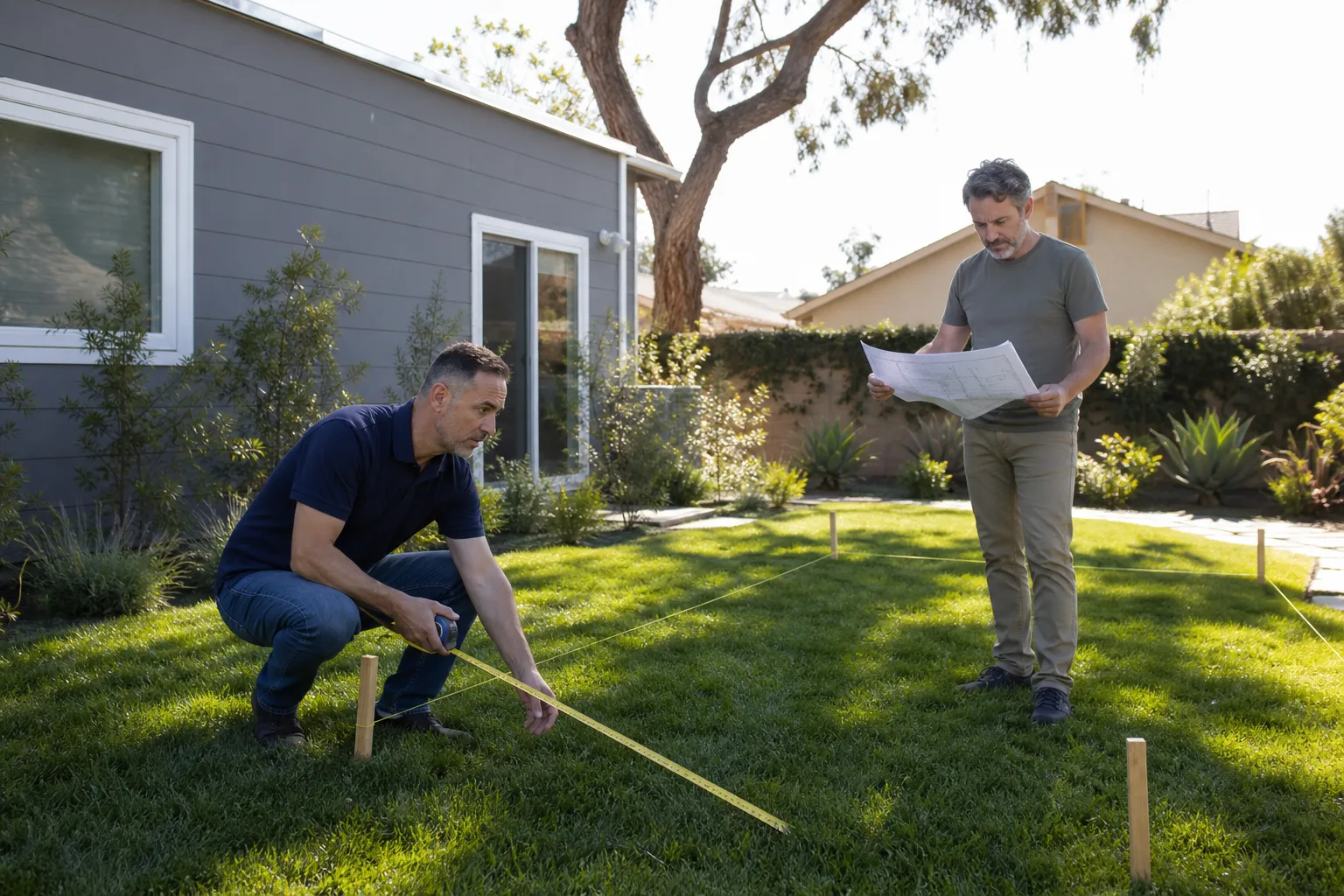
When you pull an owner-builder permit in Long Beach, you become the general contractor of record. That means you are personally responsible for hiring every subcontractor, verifying every license and workers compensation policy, scheduling every inspection, and standing behind every correction the inspector demands. A licensed GC carries that risk as a business. You carry it as an individual, against your own assets, for a decade.
Here is what the owner-builder permit allows:
- You may hire licensed subcontractors directly for electrical, plumbing, and structural work.
- You may perform work yourself in non-hazardous trades like painting, drywall, cabinetry, and flooring.
- You may pull permits for a single-family residential ADU on a property you own and occupy.
Here is what it prohibits or complicates:
- You cannot rent or lease the ADU for the first 12 months after completion without voiding the owner-builder exemption. If the city discovers an owner-built ADU being used as a rental inside that window, the permit can be invalidated.
- You assume responsibility for worker injuries on site. If an uninsured laborer gets hurt, that claim lands on your homeowners policy or personal assets.
- You must personally manage scheduling and sequencing. A missed inspection order in Long Beach can set your project back weeks, not days.
The rental restriction deserves attention. A huge share of Long Beach ADU projects are built specifically to generate income, from the rental-heavy neighborhoods near Cal State Long Beach to the multi-generational households throughout North Long Beach and Belmont Heights. If rental income is the point of your ADU, an owner-builder permit creates a 12-month legal gray zone that a professional contractor’s permit never imposes.
The 10-Year Liability Clause Nobody Mentions
California Civil Code Section 896 establishes a 10-year statute of limitations for latent construction defects on residential property. Under an owner-builder permit, you are the responsible party of record for the life of that window. If a future buyer discovers a structural or waterproofing defect in year eight, they can pursue you personally.
Here is what that means in practical Long Beach terms. Say you build an ADU on an owner-builder permit, do the framing yourself after watching a series of videos, and pass inspection. Five years later, you sell the house. Two years after that, the new owner finds dry rot at a window opening because the flashing was installed incorrectly. They file a claim. Your name is on the permit. A professional builder carries errors and omissions coverage and a workmanship guarantee that follows the structure. You carry the personal exposure.
We see this play out most often in three specific types of ADU failures in Long Beach:
- Improper window and door flashing. Coastal moisture finds its way into wall cavities within a few seasons, and by the time the rot is visible, the repair is a five-figure framing job.
- Undersized roof framing. Long Beach is not a heavy snow market, but an ADU roof still needs to carry its own dead load plus concentrated loads from rooftop equipment. Owner-built roofs with 2×4 rafters stretched past their span fail progressively.
- Flatwork drainage failures. Most owner-builders pour the ADU slab or walkway without grading away from the structure. A Long Beach winter with a few heavy storms is enough to put water under the sill plate.
The liability issue is not theoretical. When a sale is pending and the buyer’s inspector flags an unpermitted or poorly built ADU, the deal can die on the spot, or the seller eats a price reduction that dwarfs whatever was saved during construction.
The Trades Where Long Beach Inspectors Fail Owner-Built ADUs
Long Beach inspection standards for ADUs are some of the most consistent in Southern California. That consistency works against owner-builders, because the common failure points are well documented. Based on what we see on correction notices, here are the trades where owner-built ADUs in Long Beach fail most often:
Electrical. Long Beach enforces the current California Electrical Code, and ADUs trigger requirements for arc-fault circuit interrupters, tamper-resistant receptacles, and a specified number of dedicated circuits per room. Owner-builders routinely undersize the subpanel, forget the required exterior disconnect, or use romex connectors without proper strain relief. Each correction requires a re-inspection, and each re-inspection carries a fee and a scheduling wait.
Plumbing. The most common failure is improper slope on drain lines. A 1/4-inch fall per foot is the code standard, and it’s easy to get wrong on a compact ADU floor plan where every inch of the footprint matters. Inspectors also flag water heater strapping, missing cleanouts, and improper vent terminations.
Structural. ADUs in Long Beach need engineered shear wall schedules, proper hold-down placement, and a foundation tied to the main dwelling or designed as an independent structure. Owner-builders who frame first and read the plans second end up tearing out walls and redoing anchor bolt patterns. That is the single most expensive correction in residential construction, and it’s easy to avoid.
Insulation and Title 24 energy. California’s Title 24 energy code applies to all new ADUs. Long Beach inspectors check insulation R-values, window U-factors, and HVAC sizing closely. Owner-builders who buy insulation from big-box stores without checking the specific required R-value for the assembly often fail the insulation inspection and the Title 24 compliance check.
Each of these failure points has a cost attached: the re-inspection fee, the correction labor, and the calendar time lost. In Long Beach, a failed inspection can add one to three weeks to the project depending on inspector availability and corrections complexity.
What DIY Actually Saves After Permit Delays and Corrections
Let’s put numbers on the table, because the DIY savings claim usually assumes a clean, first-pass project. That’s not what happens in Long Beach for most owner-builders.
A typical 400-to-500-square-foot site-built ADU in Long Beach runs $280,000 to $380,000 through a licensed contractor, depending on site conditions, utility connections, and finish level. Acting as your own general contractor can reduce the hard-cost total by 15 to 25 percent on paper, because you remove the general contractor’s markup and overhead. On a $325,000 project, that’s $48,750 to $81,250 in theoretical savings.
Now subtract the real-world costs that DIY guides tend to ignore:
- Permit and plan check fees: $4,000 to $8,000 in Long Beach for an ADU, depending on scope, school district fees, and utility impact assessments. You pay these either way, but a professional handles the submittal and resubmittal process that owner-builders frequently get wrong on the first pass.
- Re-inspection fees: Long Beach charges per re-inspection. Budget $150 to $400 per occurrence, and expect two to four occurrences on a first-time owner-built ADU.
- Correction labor: A failed structural inspection that requires removing and reinstalling shear wall panels or anchor bolts can cost $5,000 to $15,000 in labor and materials. That single line item can erase half the savings from acting as your own GC.
- Schedule delay cost: If the ADU is meant to generate rental income, every month of delay is $1,800 to $2,800 in lost rent in Long Beach’s current ADU rental market. Three months of inspection delays is $5,400 to $8,400 in unrealized income.
- Financing inefficiency: Owner-builders often pay cash or use credit cards for materials, carrying higher interest than a construction loan a licensed contractor’s cost estimate qualifies for.
The honest math: a first-time owner-builder who executes well might net 10 to 15 percent in real savings. A first-time owner-builder who hits the common inspection failures nets closer to zero, while carrying a 10-year personal liability tail. A fixed-price professional contract with a written price before work starts removes the variance. That’s why we put the price in writing up front at Benson ADU Long Beach for every project, including ADU Builders in Long Beach work across the city.
Where Homeowners Can Safely Contribute Labor (and Actually Save Money)
You don’t have to choose between full DIY and full delegation. The economics of ADU construction in Long Beach support a hybrid model, where you handle non-permitted finish work and hand the permitted scopes to a licensed team. Our seasonal care guide shows how to protect that investment year-round. This is where homeowners save real money without taking on code liability.
Step-by-step: the smart sweat-equity plan for Long Beach homeowners.
- Hire a licensed contractor for foundation, framing, electrical, plumbing, HVAC, and roofing. These are the permitted scopes that trigger inspections. This is also where the largest share of the budget lives, and where professional execution matters most.
- Handle the non-permitted finish trades yourself or with direct-hire day labor. Painting interior walls, installing floating shelves, laying landscape fabric, planting, and assembling prefabricated storage all fall outside the permit scope.
- Do the exterior finishing work that requires no permit. Trim painting, fence staining, gravel pathways, and irrigation setup can all be owner-performed for 30 to 60 percent less than contractor pricing.
- Leave the final punch list to the contractor. The last 5 percent of any build, like caulking, door adjustments, and paint touch-ups, takes longer than it should. Let the professional crew close it out.
In our experience, Long Beach homeowners who follow this split typically save $10,000 to $25,000 compared to a full-service build, while keeping their name off the owner-builder permit. That’s the sweet spot: real savings, no liability tail, and a project that still passes inspection on schedule.
How Prefab ADUs Fit Between DIY and Full Custom Builds
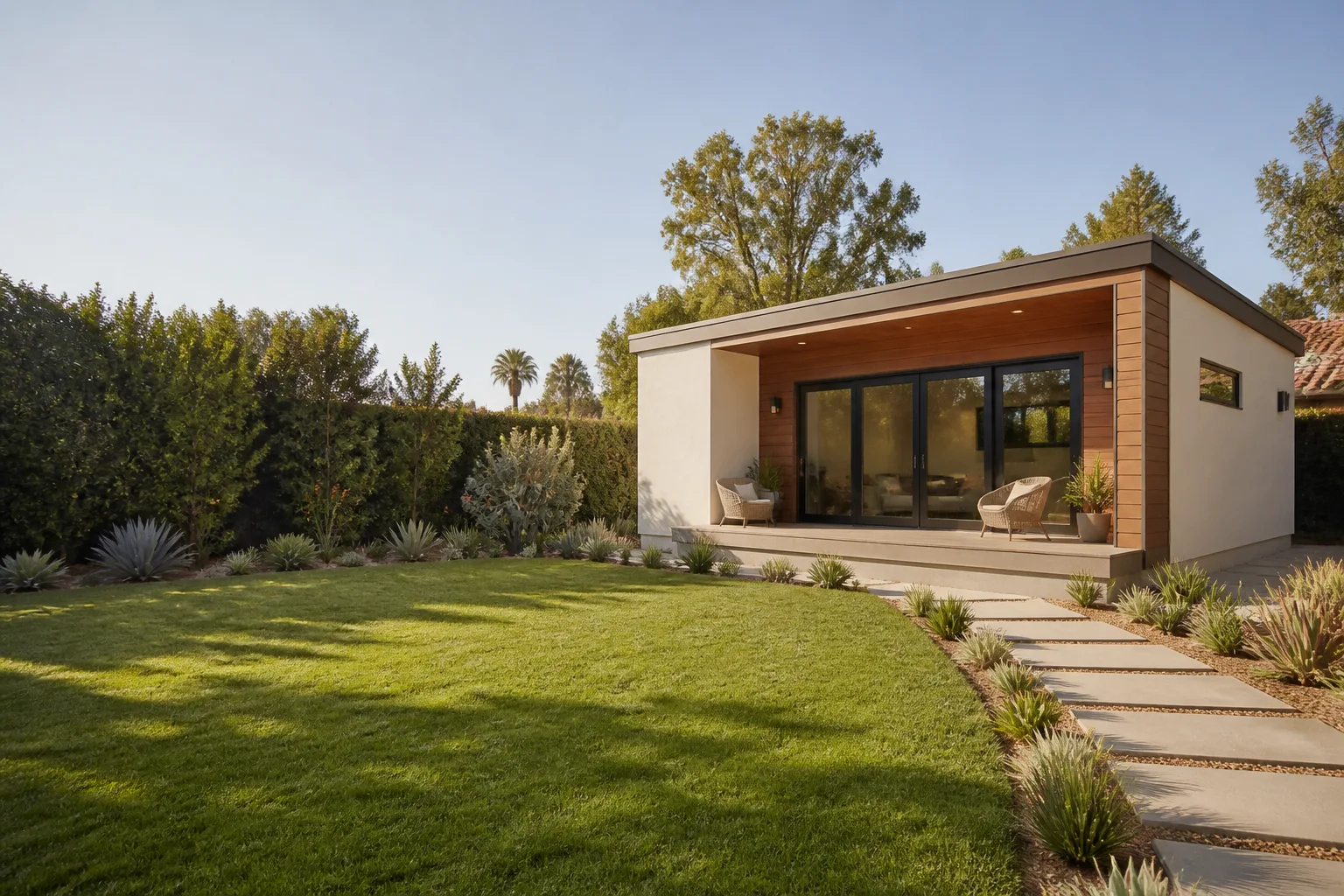
Prefab ADU brands have created a third option that sits between pure DIY and fully custom site-built construction. Companies like Abodu, Cover, and Dvele manufacture ADU modules in a factory, ship them to your Long Beach lot, and have them craned into place. The factory controls quality on the structure, while the site work, foundation, and utilities still happen on your property.
Here is where the distinction matters for a Long Beach homeowner. A prefab ADU from Abodu or Cover is not a “kit home” that arrives on a flatbed and assembles itself. The site work requires a licensed contractor in almost every case: grading, foundation, trenching for utilities, and the connection from the ADU to the main panel. Some homeowners assume prefab means no contractor at all, because the marketing copy emphasizes the factory process. The truth is that the factory handles what it handles, and a licensed contractor handles everything that happens on the ground.
Long Beach has embraced prefab ADUs faster than most Southern California cities because they offer a predictable structural base with a shorter on-site construction window. For a homeowner weighing DIY versus professional, prefab changes the math in a specific way: the risk moves from the framing and structural scope, which the factory owns, to the site work and utility connections, which remain a professional’s job. You can’t owner-build the crane pick or the utility trench, and you wouldn’t want to.
Benson ADU Long Beach works with leading prefab suppliers including Abodu, Cover, and Dvele, which means Long Beach homeowners who want a prefab ADU get the factory quality and a written price that covers the site work before anything arrives on the lot. You can compare specs on these brands yourself, and then bring us the model you want, or let us present options matched to your site.
Common Mistakes to Avoid
- Pulling an owner-builder permit when you plan to rent the ADU immediately. The 12-month rental restriction under owner-builder status in California makes this a non-starter for income-property ADUs. Long Beach is a strong rental market near Cal State Long Beach, and the lost first-year income can exceed $24,000.
- Skipping the geotechnical or soils check before foundation design. Long Beach sits on a mix of fill, sandy loam, and older alluvial deposits. The same foundation detail that works in one neighborhood can fail two blocks away, and inspectors will ask for the soils report if the site conditions warrant it.
- Framing without an engineered plan set. California ADU plans must be stamped by a licensed engineer or architect. Owner-builders sometimes try to work from sketches or online plans that don’t meet Long Beach’s structural requirements, and the correction is a full tear-out.
- Underestimating utility connection costs. Trenching a new sewer line or upgrading a main electrical panel for an ADU in Long Beach can run $8,000 to $25,000, depending on distance and existing capacity. Owner-builder budgets often skip this line entirely.
- Using unlicensed day labor for permitted scopes. If a worker is injured on an unlicensed, uninsured crew, the homeowner is the responsible party. Long Beach inspectors also flag work done by unlicensed labor when they can identify it, and it can void the permit.
- Confusing prefab with finish-complete. Prefab ADUs from brands like Abodu and Cover still require site work, foundation, and utility connections by a licensed contractor. An owner-builder who orders the module without a site plan in place creates a very expensive storage problem.
When to Call a Professional
The owner-builder path can work for a highly organized Long Beach homeowner building a small, simple ADU on a flat lot with easy utility connections, no rental plans for the first year, and a strong tolerance for paperwork. For everyone else, our more guides & resources explain the professional alternatives. That profile is rare. The professional path makes sense when the ADU is intended as a rental, when the site has any grading or drainage complexity, when the home’s existing electrical panel needs an upgrade, or when you want a written price and a guaranteed completion date instead of an open-ended schedule.
Benson ADU Long Beach offers free estimates throughout Long Beach. Call (562) 362-3885 to discuss your ADU, get a written price before any work starts, and see what the 365-Day Done Right Promise means in plain terms. No countdowns, no pressure, just the numbers on paper.
Frequently Asked Questions
A site-built ADU in Long Beach typically costs between $280,000 and $380,000 for a 400-to-500-square-foot unit, depending on site conditions, utility connections, and finish level. Prefab ADUs from brands like Abodu and Cover typically land in a similar or slightly lower range once site work is included. The best way to get an accurate number is a written estimate from a licensed contractor who has walked your specific lot. Call (562) 362-3885 for a free estimate from Benson ADU Long Beach.
Yes, but only if you occupy the property as your primary residence and accept the owner-builder permit conditions, including a 10-year liability window and a first-year rental prohibition. For most Long Beach homeowners, the legal risks of owner-builder status outweigh the savings unless you plan to live in the ADU yourself and have construction experience.
A site-built ADU typically takes 8 to 14 months from initial planning through final inspection in Long Beach, including design, permitting, and construction. Prefab ADUs can compress the on-site construction window to 3 to 6 months after site work is complete. Plan on 4 to 8 weeks minimum for permit review through the City of Long Beach, depending on current workload and plan quality.
Yes, and usually in a strongly negative direction. An unpermitted ADU can be red-tagged by the city, flagged during a buyer’s inspection, or require demolition before a sale closes. Long Beach buyers and their lenders frequently refuse to finance a property with unpermitted square footage, which limits the buyer pool and forces price concessions.
Under California Civil Code Section 896, the owner-builder is personally liable for latent construction defects for 10 years after the ADU is completed. This means a future buyer can pursue you, as an individual, for structural or waterproofing failures that emerge inside that window. A licensed contractor carries insurance and a warranty that absorbs that exposure.
In almost every case, no. The site work, foundation, and utility connections that come with a prefab ADU require licensed trades and permits in Long Beach. The factory module removes much of the structural risk, but the ground-level work is still a professional scope. Benson ADU Long Beach builds with Abodu, Cover, and Dvele and handles the full site scope under a written, fixed-price agreement.
The Bottom Line
The DIY-versus-professional ADU decision in Long Beach is usually framed as a pure cost question, but the real deciding factors are legal exposure and resale risk. An owner-builder permit puts your name on a 10-year liability chain and locks the ADU out of the rental market for its first year. The savings that survive real inspection and correction costs are modest at best, and they disappear entirely if a structural correction or a buyer’s inspection goes sideways. The practical path for most Long Beach homeowners is a hybrid: let licensed professionals carry the permitted scopes and the liability, and contribute sweat equity where the law allows. If you want a written price and a guaranteed scope before you commit, call Benson ADU Long Beach at (562) 362-3885. We’re the team on the phone, the name on the permit, and the written promise that backs the work for a full year. For a deeper look at what’s possible, start with our Benson ADU Long Beach home page, or explore our Home Addition Contractor in Long Beach and Room Addition Contractor in Long Beach services.
Written by Troy Eastman, Owner at Benson ADU Long Beach, serving Long Beach since 2006.