James Hardie Junior ADU Conversion: The Long Beach Owner’s Guide
A James Hardie junior ADU (JADU) conversion in Long Beach typically runs $55,000 to $95,000 for a complete garage or attached-space conversion, including Hardie cladding, framing, electrical, plumbing, and finish work. If you’re calling about a failed part on an existing Hardie-clad structure, the most common culprits are cracked HardiePlank lap siding at the bottom course, failed flashing at the transition between wall and foundation, or water intrusion where the original garage slab meets new framing. We stock James Hardie trim boards, lap siding, and HardieBacker board on our trucks, and we can usually diagnose and quote a repair the same day we come out. Most owners discover a problem after a winter rain, when a damp smell creeps into the converted space or paint starts bubbling along the lower three feet of an exterior wall.
Key Takeaways:
- A JADU conversion in Long Beach costs $55k to $95k, depending on the existing structure’s condition, and part-specific repairs run a small fraction of that.
- James Hardie fiber cement fails most often at the bottom course of siding, where splash-back moisture and soil contact eat through improperly flashed seams.
- We carry HardiePlank, HardieTrim, and HardieBacker in common Long Beach stock sizes and can match existing profiles the same day in most cases.
- Every Benson ADU Long Beach job comes with a written price before work starts and our 365-Day Done Right Promise in writing.
Which James Hardie Models This Applies To
James Hardie makes a range of fiber cement products, but the ones we see on Long Beach ADU and JADU conversions break into three groups: HardiePlank lap siding (the horizontal boards, usually 5/16″ or 7/16″ thick), HardiePanel vertical siding (4’x8′ or 4’x10′ sheets), and HardieTrim boards (the thicker 5/4″ profile used for corners, windows, and fascia). Each has different exposure ratings, fastening requirements, and a different failure profile. The single biggest compatibility gotcha: HardiePlank comes in 16-foot pieces and three exposure widths (4″, 5″, and 6″), and if your original contractor used a non-standard exposure, off-the-shelf replacement boards won’t line up with the existing reveal. Before you buy anything, measure the visible face of a board on your wall, not the full board width. That measurement determines what you actually need.
On the OEM versus aftermarket question for James Hardie specifically: there is no true “aftermarket” for Hardie products the way there is for HVAC or garage door parts, because Hardie fiber cement is a proprietary formulation. What you find instead are imported fiber cement boards from other manufacturers. They’re cheaper, but the color match, texture, and long-term paint adhesion behave differently. For a JADU where the cladding is doing real weatherproofing work, we recommend matching the existing product line exactly. If you have a 20-year-old JADU and the original Hardie product has been discontinued, we can walk the Long Beach building department’s current WUI (wildland urban interface) requirements and help you pick a compliant replacement. Long Beach’s proximity to coastal salt air and the San Gabriel River floodplain means the bottom 18 inches of any JADU wall takes more moisture than anywhere else on the structure.
Signs Your James Hardie Junior ADU Conversion Is Failing
- Paint bubbling or peeling along the bottom course of siding. This usually means water is wicking up from the foundation or splashing back from hardscape. The fiber cement itself doesn’t rot, but trapped moisture behind it will. In Long Beach, we see this most often on the north side of buildings where the wall never fully dries out.
- Cracks at corners or around window openings. HardieTrim is thick and brittle. When the framing behind it moves (and in Long Beach’s expansive clay soils, framing always moves eventually), the trim cracks instead of flexing. A vertical crack running along a corner board is your early warning that the underlying framing is shifting.
- Gaps opening at butt joints between siding boards. HardiePlank is designed to be installed with a small gap for expansion, but when the gap grows or the caulk pulls away cleanly, moisture is getting behind the lap. Coastal freeze-thaw cycles are rare here, but sea air and afternoon sun heat expansion is enough to work caulk loose over five to seven years.
- Soft spots or swelling at the base of the wall, especially where a garage slab meets new JADU framing. This is almost always a missing or failed Z-flashing at the transition. The slab wicks moisture, the flashing was omitted or installed wrong, and now the bottom plate of the new framing is compromised. We have fixed enough of these in Wrigley and Bixby Knolls to know exactly what awaits once we open the wall.
- Mold smell inside the JADU after rain, with no visible leak inside. Water is entering the wall cavity from behind the siding and running down the water-resistive barrier. You won’t see it until it’s already done damage. If you smell it, call us before you repaint: paint just seals the problem in.
Replacement Cost & What’s Included
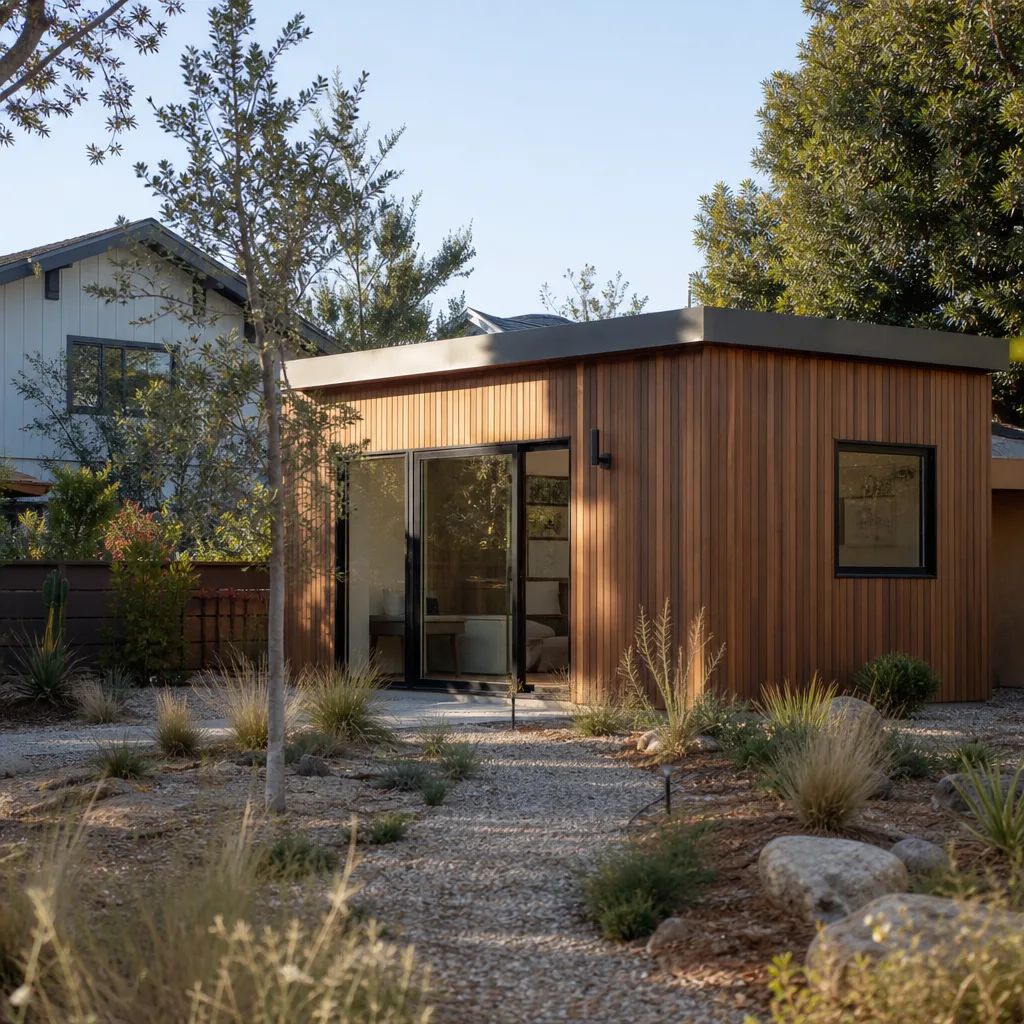
For a part-level repair on a James Hardie-clad JADU in Long Beach, expect $750 to $2,800 for a typical siding or trim repair that includes removing damaged boards, inspecting the water-resistive barrier and flashing behind them, replacing what’s compromised, and repainting to match existing color. Larger repairs that involve reframing a rotted bottom plate or replacing an entire wall section run $4,200 to $9,500. A full re-side of a standard 400-square-foot JADU with new HardiePlank and HardieTrim runs $22,000 to $38,000, including permit-ready drawings if the city asks for them.
Here’s what drives the number: how far the damage extends into the framing, whether we’re matching an existing paint color (most are, and we can scan and match it on site), ladder access versus scaffold access, and whether the JADU is detached or attached. Every quote from Benson ADU Long Beach is a written line-item price before work starts. You’ll see parts, labor, materials, and permit fees called out separately. No change orders because we guessed wrong at the estimate. Troy walks every JADU quote himself before it goes to you, and the 365-Day Done Right Promise covers the repair for a full year. If it fails within that window, we come back and fix it on our own dime.
DIY or Call Us?
What you can safely do yourself: clean your gutters and downspouts, trim vegetation back from the siding, and re-caulk visible gaps with a quality exterior polyurethane caulk. Those are low-risk and genuinely help. What you should not do yourself: pull off siding boards to “check behind them.” Fiber cement is heavy and brittle, and when a board breaks mid-pull, it leaves a jagged edge that will slice through work gloves. More importantly, once you open a wall, you’re responsible for reinstalling the water-resistive barrier and flashing correctly. Get the flashing wrong and you’ve converted a $900 repair into a $9,000 one. If you see bubbling paint, cracking trim, or a gap at the slab line, call (562) 362-3885. We’ll tell you over the phone whether it’s something you can watch or something we should see this week. Honest answer either way, and the estimate is free.
FAQs
James Hardie fiber cement products carry a 30-year limited warranty, but the real-world lifespan on a Long Beach JADU is 15 to 25 years before you’ll tackle your first meaningful repair, depending on sun exposure and how close you are to the water. Bottom-course boards near soil or hardscape tend to need attention around year 10 to 12. Call (562) 362-3885 and we can tell you whether your siding is at mid-life or end-of-life.
Hairline cracks under 2 inches can sometimes be stabilized with a quality elastomeric patch, but any crack that runs the full width of the board or sits at a corner needs board replacement. Patching a structural crack just hides the problem for a season. For an exact read on your wall, call (562) 362-3885 for a free on-site evaluation.
A single-board repair takes one to two hours on site. A full wall section with reframing and flashing takes one to two days. A complete JADU re-side runs two to three weeks, depending on whether we’re also pulling and resetting windows and trim. We’ll give you a written timeline with the written price, so you know the schedule before you sign anything.
We stock common HardiePlank exposures in 5/16″ and 7/16″ thicknesses, HardieTrim in the most-used Long Beach profiles, and HardieBacker board on our trucks. Less common profiles take 2 to 5 days from our local supplier. You never need to order materials yourself; the parts, the pickup, and the delivery logistics are all part of the written price. Call (562) 362-3885 to confirm we have your profile on the truck today.
Get Your JADU Back to Weathertight
A James Hardie-clad JADU is one of the toughest structures you can put on a Long Beach lot, but it’s only as good as its flashing and its bottom course. If you’ve got bubbling paint, cracking trim, or a smell inside that tells you water’s getting in, don’t wait for the next winter storm to show you where the weak spot is. Call Benson ADU Long Beach at (562) 362-3885 and schedule a free estimate. We also build and repair with Abodu, Cover, and Dvele prefab systems, so if your JADU needs more than parts, we can talk through the full picture. Every promise in writing before a single shovel turns. You’ll get a written line-item price, a real arrival time, and a 365-Day Done Right Promise on the work. We’re not affiliated with James Hardie, but we’ve installed and repaired their products across Long Beach long enough to know exactly what works and what doesn’t here.
Written by Troy Eastman, Owner & Lead Builder, Benson ADU Long Beach, serving Long Beach and nearby areas.